

Abstract
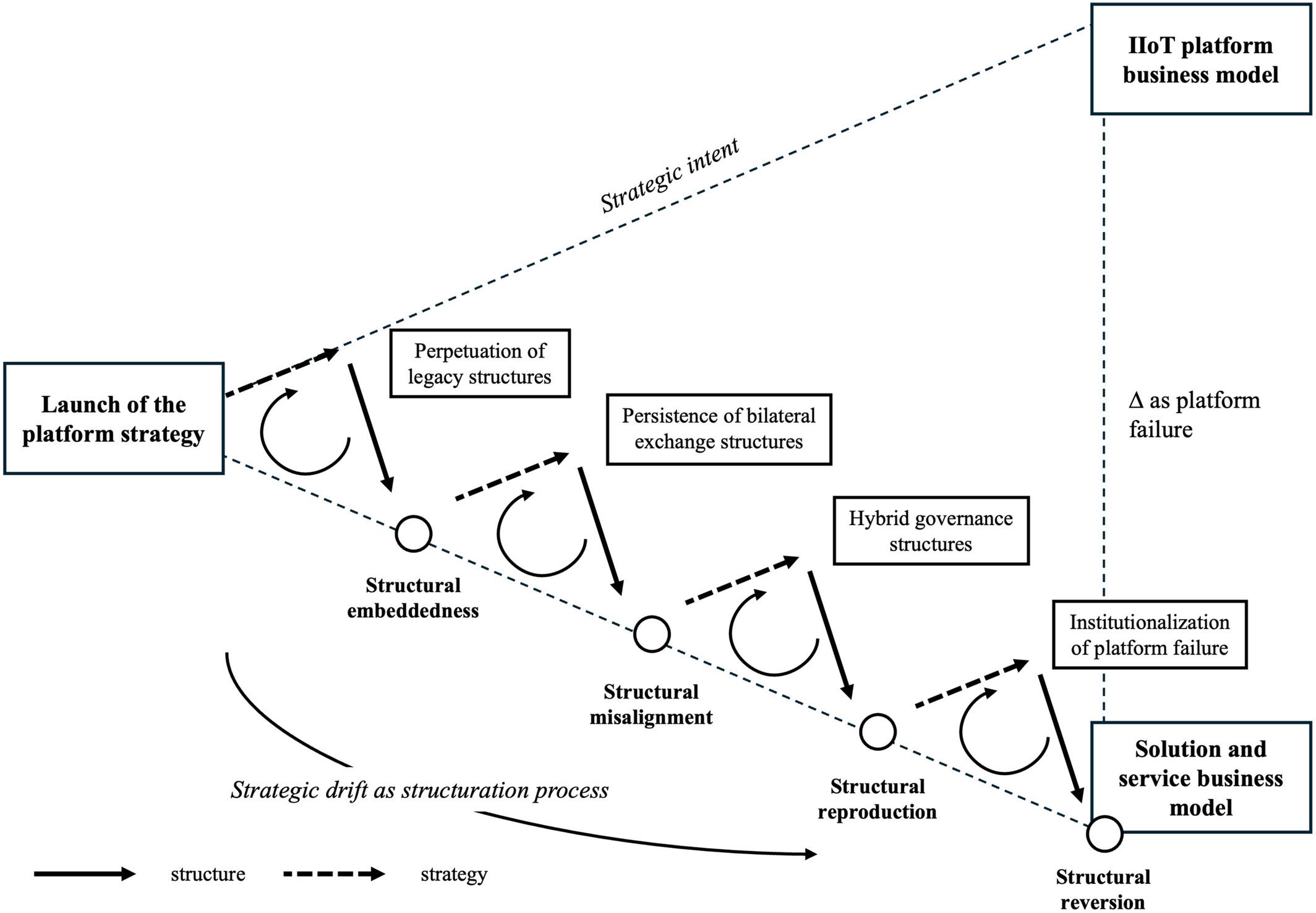
Despite their transformative potential, Industrial Internet of Things (IIoT) platforms often fail to evolve into scalable ecosystems. Research on IIoT platforms attributes failure to discrete factors such as governance misalignment or technological complexity and rarely considers how failure unfolds. This article adopts a structuration theory perspective to examine IIoT platform failure as a path‐dependent process. Through a seven‐year longitudinal case study of Alpha, a global industrial manufacturer, we identify four structuration mechanisms—structural embeddedness, misalignment, reproduction, and reversion—that progressively constrain platform scalability. Our findings reveal that failure is not a singular event but an emergent outcome shaped by recursive interactions between architecture, governance, and market structures, as well as strategic actions. We contribute to platform governance research by showing that IIoT platforms inherit, rather than impose, governance structures, making it crucial for firms to actively reshape contracting dependencies rather than replicating existing structures. Based on these insights, we provide recommendations for firms to design governance frameworks that foster openness, modularity, and ecosystem scalability from the outset. These insights offer a more dynamic understanding of IIoT platform evolution, informing theory and practice on overcoming the barriers to the scalability of IIoT platforms.
Kernstock, P., Hein, A., Schreieck, M., & Krcmar, H. (2026). Why Industrial Internet of Things Platforms Fail: A Structuration Theory Perspective on Platform Evolution. Journal of Product Innovation Management. doi: https://doi.org/10.1111/jpim.70039