

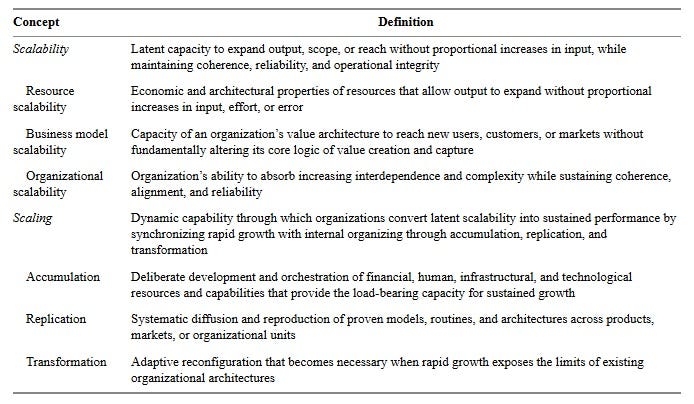
Despite a surge in scholarly interest, research on scalability and scaling remains fragmented with conceptual ambiguity and limited theoretical integration across disciplines. This review addresses these shortcomings by developing an integrative process model that synthesizes and links three distinct, yet interrelated dimensions of scalability—namely, resource, business model, and organizational scalability—to scaling as a dynamic capability and its consequences. Drawing on a systematic synthesis of 193 articles from management research, we clarify the conceptual distinction between scalability and scaling and reveal how their recursive interdependencies generate both virtuous and vicious growth dynamics. Moreover, we identify key mechanisms and contingencies that explain when scalability translates into scaling and sustained performance, and when it instead produces organizational strain, inequality, or environmental harm. Our framework encourages a balanced understanding of scaling as both an enabler of persistent high growth and a potential source of adverse spillovers. In so doing, our review establishes a unifying foundation for interdisciplinary research on the dynamics, limits, and consequences of scalability and scaling across organizations and society at large.
Full reference: Jansen, J. J., & Tippmann, E. (2026). Scalability and scaling in management research: Toward a process model integrating fragmented literatures. Academy of Management Annals. Doi: https://doi.org/10.5465/annals.2025.0099