


Legacy firms do not need to become platforms to benefit from platform thinking. The more practical question is which business problems can be addressed by selectively introducing platform mechanisms into an established business model.
This paper adopts a problem-driven perspective to examine how incumbent firms use platform thinking in practice. Based on a systematic content analysis of platform initiatives launched by S&P 500 companies, the study screened 796 initiatives and identified 140 that displayed the defining characteristics of a platform: interdependent user groups, cross-side network effects, and a transactional, innovation, or orthogonal platform logic.
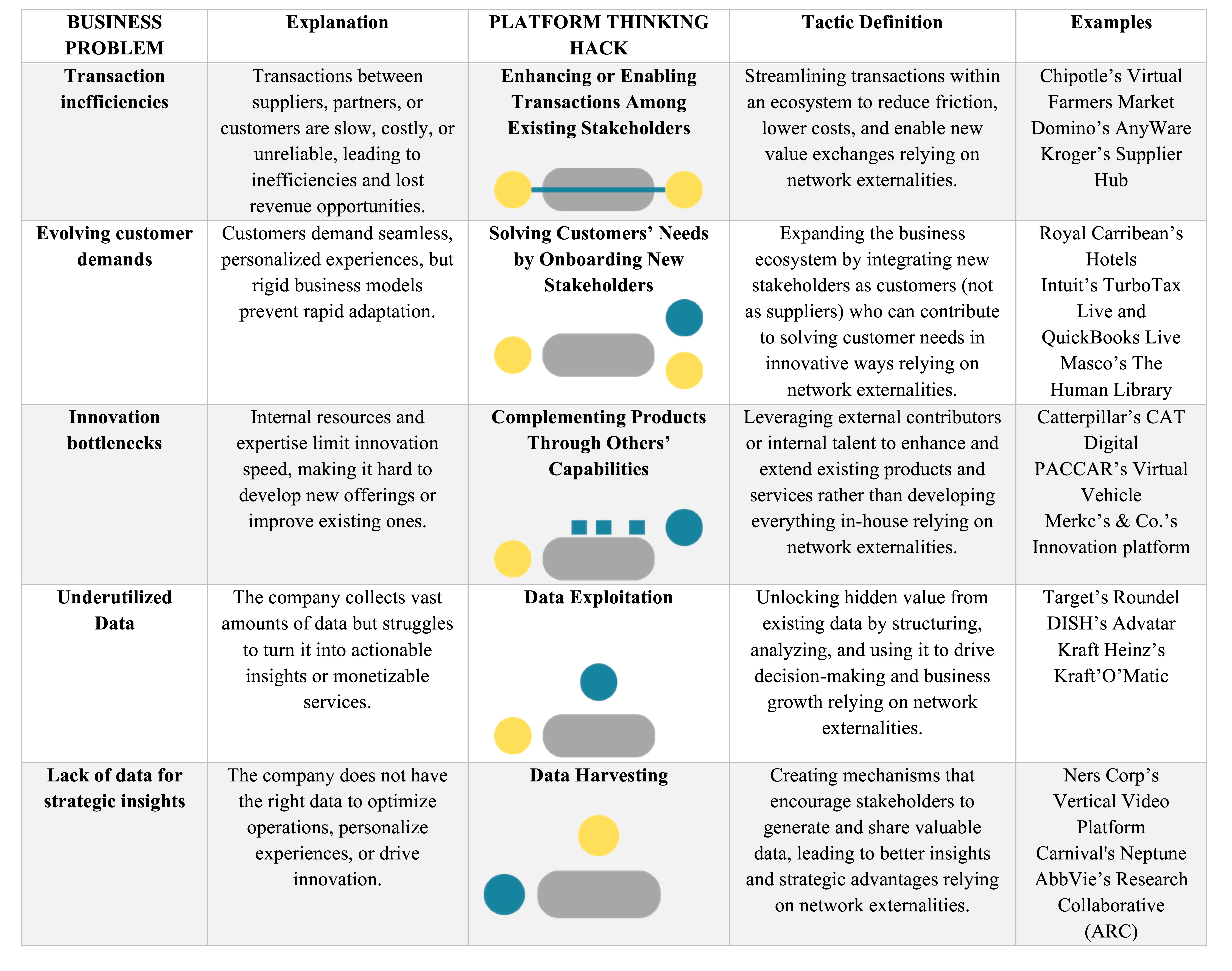
The analysis identifies five recurring business problems and five corresponding “platform thinking hacks.” Firms address transaction inefficiencies by enhancing exchanges among existing stakeholders; respond to evolving customer demands by onboarding new stakeholders that complement the customer experience; overcome innovation bottlenecks by enabling external actors to build on their products and technological assets; exploit underutilized data by connecting existing data flows with new users; and address the absence of strategic information by creating incentives for stakeholders to generate and share new data.
These problem–hack pairs are not presented as universal best practices, but as empirically observed managerial heuristics. Transactional platforms are typically used to reduce friction or extend the value proposition, innovation platforms allow complementors to enrich existing products and services, while orthogonal platforms support data exploitation and data harvesting. Representative cases include Chipotle’s Virtual Farmers’ Market, Intuit’s TurboTax Live, PACCAR’s Virtual Vehicle, Target’s Roundel, and Carnival’s Neptune.
The study contributes to platform and innovation management research by shifting attention from platform typologies to managerial motivations. Rather than beginning with the question, “Which type of platform should we build?”, the paper suggests starting with, “Which problem are we trying to solve?” Platform typologies therefore become a repertoire of mechanisms that incumbent firms can mobilize selectively, without abandoning their existing business models or attempting a complete platform transformation.
For managers, the paper proposes a practical decision sequence: diagnose the business problem, identify the platform logic suited to that problem, assess organizational readiness, and then design the required governance mechanisms, incentives, technological interfaces, and risk controls. The five hacks require different capabilities. Transactional initiatives can often begin with a minimum viable interaction, innovation platforms require technological openness and complementor governance, while data-oriented platforms depend on data quality, legitimacy, trust, and clear value propositions for both data generators and data users.
Reference: Trabucchi, D., & Buganza, T. (2026). Five business problems platform thinking helps legacy firms solve. Business Horizons, forthcoming. https://doi.org/10.1016/j.bushor.2026.07.002
Here you find the full paper: https://doi.org/10.1016/j.bushor.2026.07.002