

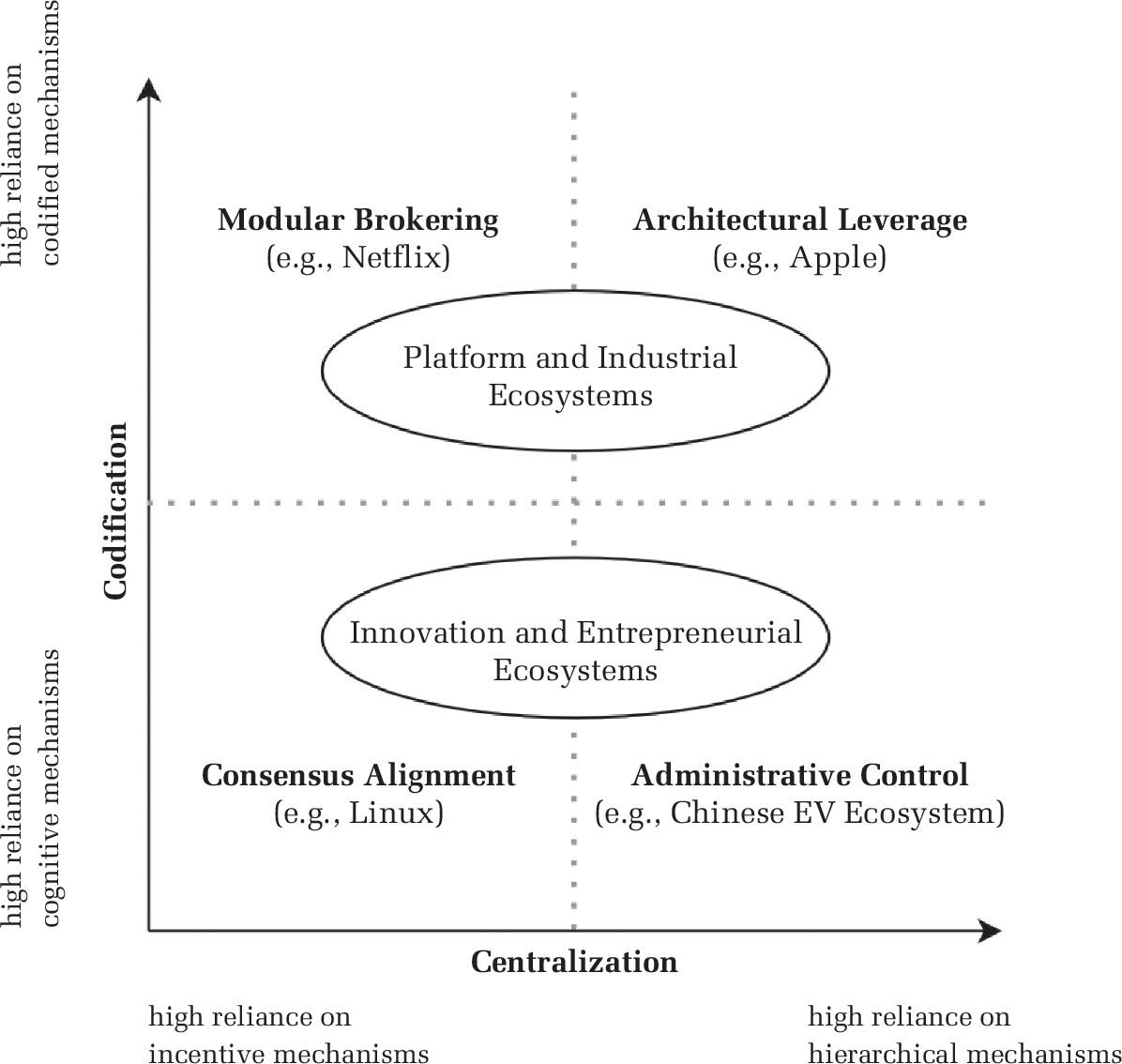
Value creation is increasingly shifting from standalone firms in linear value chains toward multilaterally coordinated efforts among heterogeneous actors in ecosystems. Yet, we know relatively little about how coordination unfolds when value creation activities are distributed in this manner. As a focal entity grows increasingly reliant on actors beyond its formal authority, value creation and capture depend on aligning and steering these interdependent actors through indirect means—an approach best described as “orchestration.” We define “ecosystem orchestration” as the application of control and coordination mechanisms beyond organizational boundaries to integrate complementary efforts across ecosystem participants. First, through a comprehensive integrative review, we identify four categories of mechanisms: codified, cognitive, incentive, and hierarchical. We then examine how these mechanisms are bundled into distinct orchestration regimes across platform, industrial, innovation, and entrepreneurial ecosystems. Further, we highlight salient connections between these mechanisms and classic theories of the firm—resource-based view, property rights theory, transaction cost economics, and knowledge-based view. By moving beyond generic notions of orchestration and revealing its underlying mechanisms, we establish a clearer foundation for advancing ecosystem research, integrate the fragmented ecosystem orchestration literature, and anchor it more firmly in established theories. Finally, we conclude by outlining conceptual, empirical, and methodological directions for future inquiry.
Full reference: Mozheiko, S., Shi, X., & Tong, T. W. (2026). Ecosystem Orchestration: Mechanisms, Regimes, and Theories of the Firm Foundations. Academy of Management Annals, (ja), annals-2025. Doi: https://doi.org/10.5465/annals.2025.0078